
Poisoning, collisions and electrocutions from energy infrastructure, habitat loss, disturbance during breeding, reduced availability of safe food, and ingestion of toxic veterinary drugs or lead fragments.
Species found in South Africa: Six: African White-backed Vulture, Lappet-faced Vulture, Hooded Vulture, White-headed Vulture, Cape Vulture and Bearded Vulture
Family: Accipitridae (Old World Vultures)
Conservation status: Vulnerable to Critically Endangered (IUCN Red List of Threatened Species); the Bearded Vulture is Regionally Critically Endangered in Southern Africa
Population trend: Decreasing across all six species
Range: Fragmented populations across South Africa, with strongholds in Zululand, KwaZulu-Natal, and the Maloti-Drakensberg mountains of the Southern Drakensberg
Habitat: Open savanna and bushveld for tree-nesting species; high-altitude cliffs and mountain terrain for cliff-nesting species
Diet: Obligate scavengers, feeding almost exclusively on carrion
Nesting: Tree-nesting: African White-backed, Lappet-faced, Hooded and White-headed Vultures. Cliff-nesting: Bearded and Cape Vultures
Average lifespan: Up to 30 years in the wild for cliff-nesting species
Ecological role: Nature's clean-up crew, removing carcasses and limiting the spread of disease to humans and animals
Vultures (also known as nature's clean-up crew) are among the most threatened group of birds on the continent, with all six species found in South Africa currently listed as Vulnerable, Endangered, or Critically Endangered on the IUCN Red List of Threatened Species. They are large, broad-winged birds of prey found across South Africa, from the open savanna and bushveld of Zululand to the high-altitude cliffs of the Maloti-Drakensberg mountains. In KwaZulu-Natal, breeding pairs across all species have declined by an estimated 70 to 80 percent since 2004, driven primarily by poisoning.
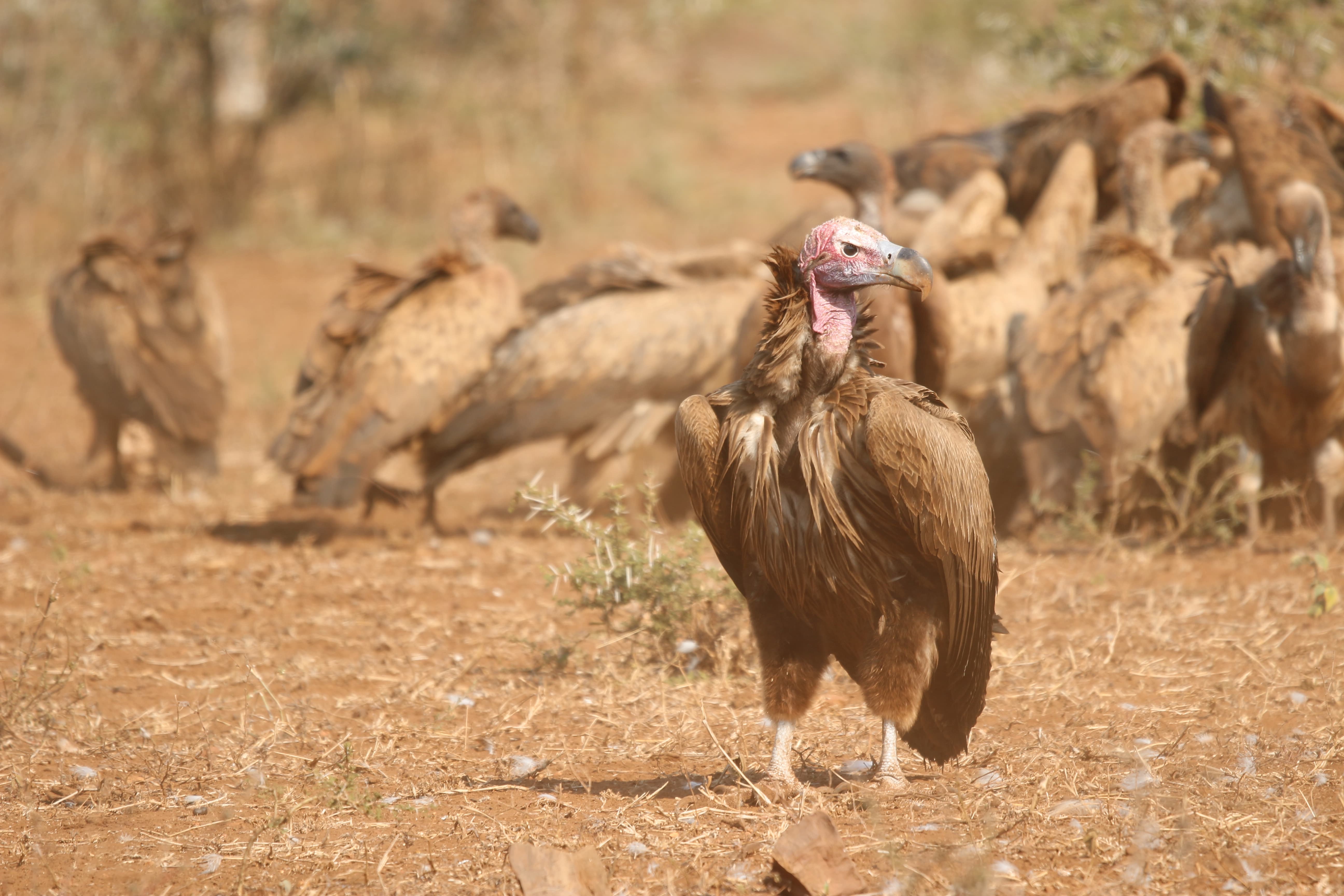
They are characterised by bald or lightly feathered heads, an adaptation that helps keep them clean while feeding deep inside carcasses, and each species occupies a distinct feeding niche within the Vulture guild, from the powerful, hide-tearing bill of the Lappet-faced Vulture to the bone-feeding habits of the Bearded Vulture. Vultures typically feed and roost communally, sometimes in large numbers, with a group perched together known as a venue and a group circling overhead known as a kettle.
Vultures typically breed only once a year, with most South African species laying a single egg per breeding season during the cooler winter months. Incubation lasts approximately 55 days, after which the chick will remain dependent on both parents for anywhere from five months to two years, depending on the species. Nest sites vary from tree colonies in open woodland, used by the African White-backed, Lappet-faced, Hooded and White-headed Vultures, to remote cliff ledges and potholes used by the Bearded Vulture and Cape Vulture in the Maloti-Drakensberg.
As obligate scavengers, Vultures feed almost exclusively on carrion, playing a critical role in removing carcasses from the landscape and limiting the spread of disease to both humans and other animals.
Due to their endangered status, Vultures are a focal species for Wildlife ACT, with a significant portion of our conservation efforts based around their protection. Our monitoring of Vultures spans both Zululand and the Southern Drakensberg, combining nest surveys, GPS tracking and rapid emergency response to poisoning events. Our ultimate goal is to stabilise South Africa's Vulture species and ensure the protection of their populations into the future.
Wildlife ACT has been at the forefront of Vulture conservation in South Africa for more than a decade. Working in close collaboration with Ezemvelo KZN Wildlife, the Endangered Wildlife Trust, BirdLife South Africa, Project Vulture and the Bearded Vulture Task Force, the organisation delivers science-led monitoring, tracking and emergency response across two core landscapes: the tree-nesting species of Zululand and the cliff-nesting species of the Southern Drakensberg.
Wildlife ACT deploys lightweight, solar-powered GPS tracking units, developed in part by Wildlife ACT Innovations, to adult and fledgling Vultures across Zululand. In April 2026, Wildlife ACT and Ezemvelo KZN Wildlife deployed 19 GPS units to African White-backed Vultures in Hluhluwe-iMfolozi Park in a two-day operation, the largest single tracking deployment for the species in the province. Wing tags and leg rings provide additional individual identification, with public sightings reported through Project Vulture. This data feeds into provincial and national databases to guide safe feeding site management and emergency response priorities.
In Zululand, Wildlife ACT's work is delivered primarily through the Zululand Vulture Project, in partnership with Ezemvelo KZN Wildlife. The project focuses on the four tree-nesting species: the African White-backed Vulture, Lappet-faced Vulture, Hooded Vulture and White-headed Vulture. In September 2025, the project confirmed the first active Hooded Vulture nest ever recorded in KwaZulu-Natal, also the southernmost breeding record for the species globally.
In the Southern Drakensberg, Wildlife ACT's Southern Drakensberg Conservation Programme focuses on the Bearded Vulture and Cape Vulture, in partnership with the Bearded Vulture Task Force and Ezemvelo KZN Wildlife. Nest monitoring runs from May to November each year, conducted from safe vantage points using optics. Wildlife ACT also operates the Mzimkulu Vulture Hide, a Vulture Safe Feeding Site within the Maloti-Drakensberg Park World Heritage Site, supporting a minimum of 500 Cape Vultures and 20 Bearded Vultures annually while providing a platform for public education.
Wildlife ACT maintains a dedicated Emergency Response Team that responds to poisoning and other emergency alerts across KwaZulu-Natal. GPS-tagged Vultures that become stationary for extended periods or congregate unexpectedly can flag a potential poisoning site. Trained teams then assess the scene, recover surviving birds, collect samples for toxicology and decontaminate the area. Wildlife ACT has responded to more than 60 poisoning alerts in Zululand since 2019.
Wildlife ACT conducts blood and bone lead level testing on Vultures captured during field operations, both in-field and in the laboratory, to understand the extent of lead exposure and inform future policy on the use of lead ammunition in the environment. Wildlife ACT also contributed to South Africa's national Biodiversity Management Plan for Vultures, gazetted in 2024.
Through consistent, science-led fieldwork and collaborative partnerships, Wildlife ACT continues to work toward a future where South Africa's six Vulture species recover and persist.
Vultures in South Africa face a complex combination of threats that continue to drive population declines across all six species. These challenges stem largely from human activity, compounded by the birds' own slow reproductive biology. Together, they make Vultures one of the most threatened groups of birds on the continent.
Poisoning is one of the most significant threats facing Vultures in South Africa. Poisoning events fall into two categories. Intentional poisoning includes carcasses deliberately laced to harvest Vulture parts for traditional medicine, or to kill perceived predators such as jackals, leopards and hyaenas in retaliation for livestock losses. Unintentional poisoning occurs when Vultures ingest toxic veterinary drugs, such as certain non-steroidal anti-inflammatory drugs used to treat livestock. Because Vultures feed communally, a single poisoned carcass can kill 50 or more birds in one event. Breeding pairs in northern KwaZulu-Natal have declined by an estimated 70 to 80 percent since 2004, largely as a result of poisoning.
Due to their wide wingspans, Vultures are highly susceptible to colliding with or being electrocuted by power lines. This threat affects Vultures across their foraging range, which for species such as the African White-backed Vulture can extend beyond 70,000 km2.
Lead exposure from ammunition fragments in carcasses poses a well-documented risk to Vulture populations. More than a third of sampled African White-backed Vultures in KwaZulu-Natal show elevated blood lead levels. Unlike a single poisoning event, lead exposure acts as a slow, cumulative threat to Vulture health across all scavenging species.
The conversion of natural landscapes into agricultural and urban areas has reduced suitable nesting habitat for tree-nesting species, while disturbance at breeding cliffs threatens the Bearded Vulture and Cape Vulture in the Southern Drakensberg. Reduced availability of safe, uncontaminated food sources compounds this pressure, driving Vultures to forage over wider areas where the risk of encountering poisoned bait increases.
Vultures mature late and raise very few young. Most species lay a single egg per breeding season, and some, such as the White-headed Vulture, skip breeding entirely in years when still caring for a dependent chick from the previous season. This limits how quickly populations can recover from the loss of breeding adults, and small, isolated populations face reduced genetic diversity that further limits their ability to adapt to environmental change. Protecting adult survival is therefore a central conservation priority for every Vulture species in the region.
South Africa's Vulture populations have declined sharply over the past two decades. In northern KwaZulu-Natal, breeding pairs across all species have declined by an estimated 70 to 80 percent since 2004, driven primarily by poisoning.
African White-backed Vulture: Approximately 4,000 breeding pairs in South Africa
Cape Vulture: Approximately 4,500 breeding pairs across southern Africa, with about 20 percent residing in the Maloti-Drakensberg
Lappet-faced Vulture: Approximately 180 breeding pairs nationally, with only two to six active nests remaining in KwaZulu-Natal, down from 15 in 2020
Bearded Vulture: 50 to 100 breeding pairs across South Africa and Lesotho, confined entirely to the Maloti-Drakensberg mountains
Hooded Vulture: 50 to 100 breeding pairs, with the first confirmed KwaZulu-Natal nest recorded in September 2025
White-headed Vulture: 80 to 100 breeding pairs nationally; confirmed regionally extinct as a breeding species in KwaZulu-Natal since 2021
Wildlife ACT's monitoring teams in Zululand and the Southern Drakensberg contribute to regional and national population management by collecting data on nest occupancy, breeding success, movement patterns and survival. This information feeds into provincial databases and South Africa's national Biodiversity Management Plan for Vultures, gazetted in 2024, to guide safe feeding site management and emergency response priorities.
While numbers remain low across most species, targeted conservation partnerships and landscape-scale collaboration are helping to stabilise some populations. Continued monitoring, poisoning response and community engagement remain essential for long-term Vulture conservation in South Africa
Of the six Vulture species that occur in South Africa, all are either Vulnerable, Endangered, or Critically Endangered.
Vultures are obligate scavengers, feeding almost exclusively on carrion rather than hunting live prey. Four of South Africa's six species nest in trees across open savanna and bushveld: the African White-backed Vulture, Lappet-faced Vulture, Hooded Vulture and White-headed Vulture. The remaining two, the Bearded Vulture and Cape Vulture, nest on cliffs in mountainous terrain. Each species occupies a distinct feeding niche within the Vulture guild. The Lappet-faced Vulture uses its large, powerful bill to open tough hide and access carcasses that other species cannot penetrate. The African White-backed Vulture feeds in large, competitive groups once a carcass is open. The Hooded Vulture picks at scraps on the periphery. The Bearded Vulture feeds almost entirely on bone, carrying fragments into the air and dropping them onto rock surfaces to access the marrow inside.
Vultures provide a critical ecosystem service by removing carcasses and organic waste from the landscape faster than any other scavenger, limiting the spread of diseases such as anthrax, botulism and cholera to both humans and animals. In KwaZulu-Natal, where livestock farming and direct reliance on the environment are widespread, this sanitation service supports both human health and the regional economy. The decline of Vulture populations increases the time carcasses remain on the landscape, raising disease risk for people and animals alike.
Today, the survival of South Africa's Vulture species depends on targeted conservation strategies focused on nest monitoring, GPS tracking, emergency response and habitat protection. Collaborative efforts led by organisations such as Wildlife ACT, Ezemvelo KZN Wildlife, the Endangered Wildlife Trust, BirdLife South Africa and Project Vulture have contributed to South Africa's national Biodiversity Management Plan for Vultures, gazetted in 2024. Through intensive monitoring, GPS tracking and rapid emergency response, these conservation initiatives are working to stabilise breeding populations across KwaZulu-Natal's Zululand region and the Southern Drakensberg.
Of the 16 Old World Vulture species found globally, nine occur on the African continent, and six of those occur in South Africa.
A group of Vultures perched together is called a venue. A group of Vultures circling in the air is called a kettle.
Vultures can eat up to 20 percent of their own body weight in a single feeding.
Vultures are highly efficient at locating carrion. Their digestive system can safely process pathogens such as anthrax, botulism and cholera that would be fatal to most other animals.
The Bearded Vulture is the only known vertebrate species whose diet consists almost entirely of bone, using stomach acid with a pH close to one to dissolve bone fragments.
Unlike the other five species, the Bearded Vulture is not bald-headed. Its fully feathered head is an adaptation to the cold, high-altitude climate of the Maloti-Drakensberg mountains.
The Cape Vulture is southern Africa's only endemic Vulture species, found nowhere else in the world.
Different Vulture species play different roles at a feeding site. The Lappet-faced Vulture uses its powerful bill to open tough carcasses for other species, the African White-backed Vulture feeds in large competitive groups, and the smaller Hooded Vulture patrols the periphery for scraps.
Vultures are naturally very clean birds and typically bathe at a favourite site on a daily basis.
The conservation of South Africa's Vulture species depends on ongoing fieldwork, GPS tracking technology and skilled field teams. Donations to Wildlife ACT help fund solar-powered GPS units, emergency response equipment, safe feeding site management and the salaries of dedicated conservation staff who monitor and protect these Endangered and Critically Endangered birds every day.
Supporters can also contribute directly through the Vulture Programme Wishlist, which lists specific equipment needed by monitoring teams in Zululand and the Southern Drakensberg. To raise awareness, consider downloading a FREE bookmark template to colour in and sharing your creation with your network. Every contribution strengthens the collective effort to safeguard South Africa's six Vulture species within KwaZulu-Natal's protected areas and beyond.